Campus Food Systems Workshop
Student Perspectives on Sustainable Food, Engagement & Local Systems
Introduction
Workshop on Campus Food Systems – Student Perspectives
This repository documents the results of a participatory workshop on food systems on campus. Students discussed challenges and possible solutions related to food quality, sustainability, local food systems, and student participation in food-related decision-making.
Workshop Details:
- Hosted at the Green Office of the University of Hohenheim
- Organized by students from the course "Enacting Local Transformation in the Agri-Food System"
- Participants shared ideas through guided discussions and interactive poster activities
- Funded by Stiftung Innovation in der Hochschullehre through the TREE project module
Repository Contents:
- Workshop guiding materials and questions
- Summarized results from participant discussions
- Photos of the posters where students shared their responses and ideas
- Structured data from feedback collected during the workshop
📋 Guided Questions
These documents contain the guided questions used during the workshop to facilitate discussion. The questions helped participants reflect on key topics such as food diversity, sustainability, local food connections, and student influence on campus food systems. They served as the framework for group conversations and idea generation. The responses collected from these prompts informed the workshop results.
Guided Questions 1
Topic: Food on Campus
Explores questions about food quality, choice & healthy lifestyle; sustainability, climate & resource use; campus as a living agrifood system; and local food & student connection.
Download PDFGuided Questions 2
Topic: Student Engagement
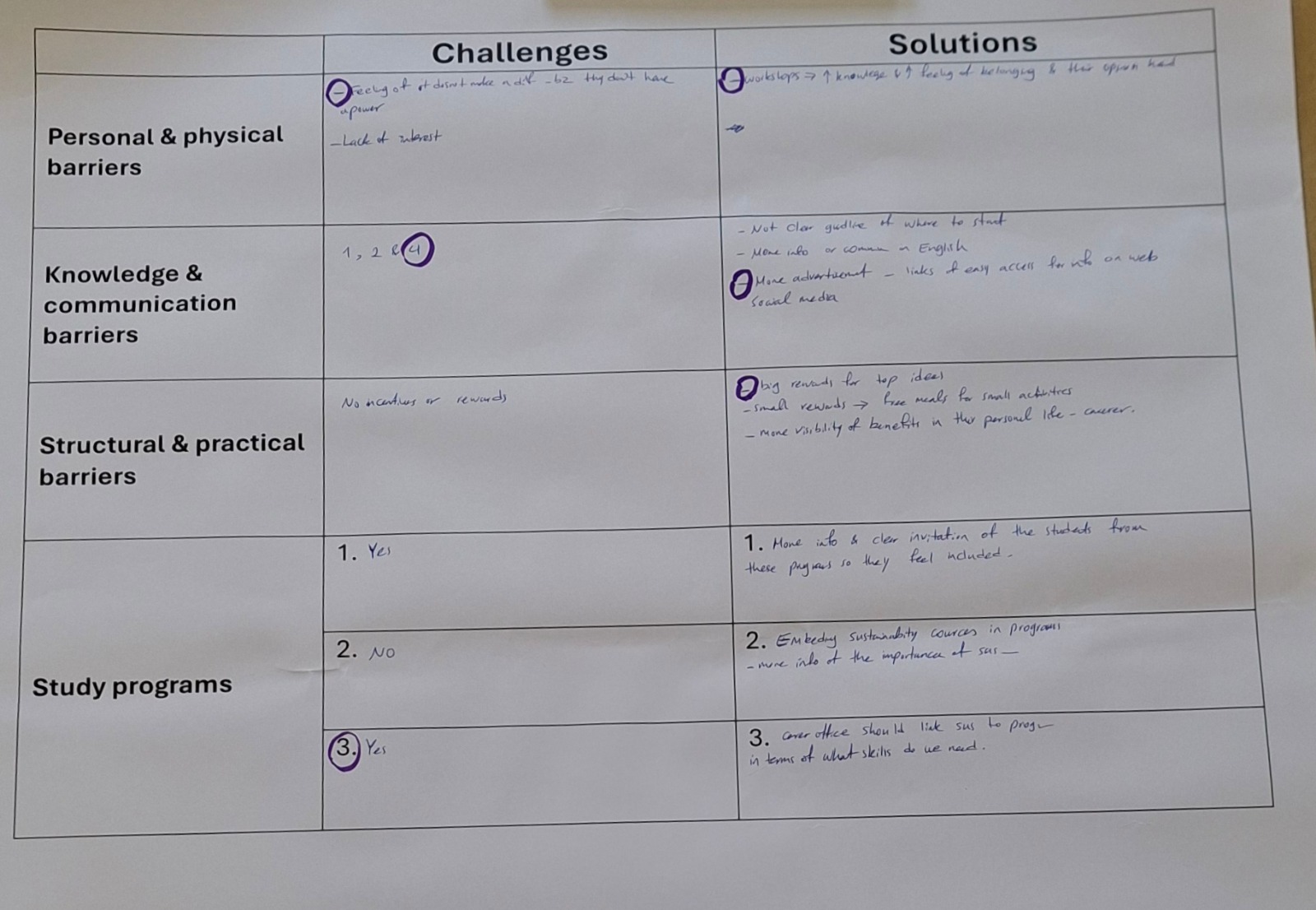
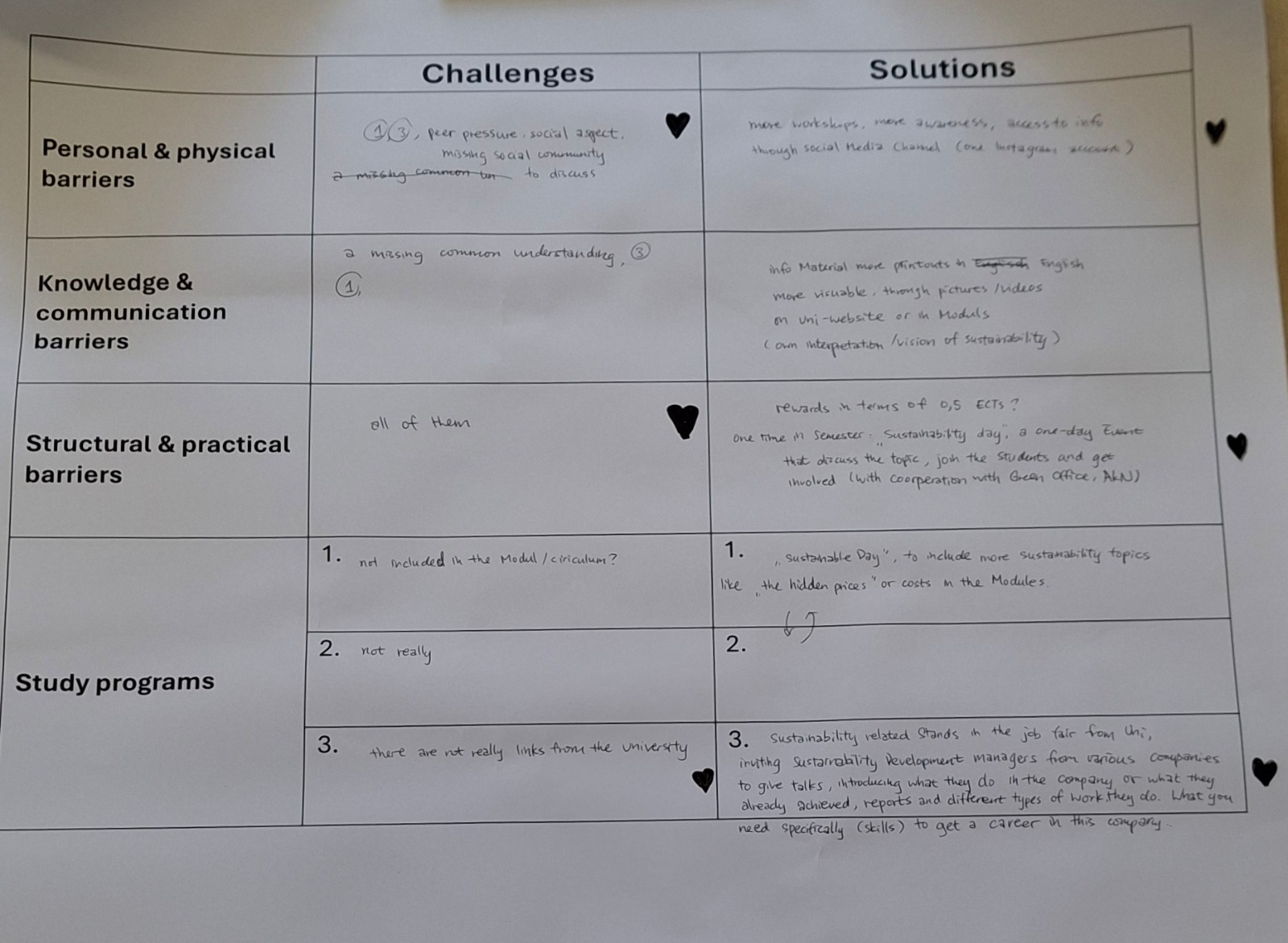
Addresses barriers to student engagement including personal & physical barriers, knowledge & communication barriers, structural & practical barriers, and study program considerations.
Download PDF🖼️ Workshop Feedback & Student Posters
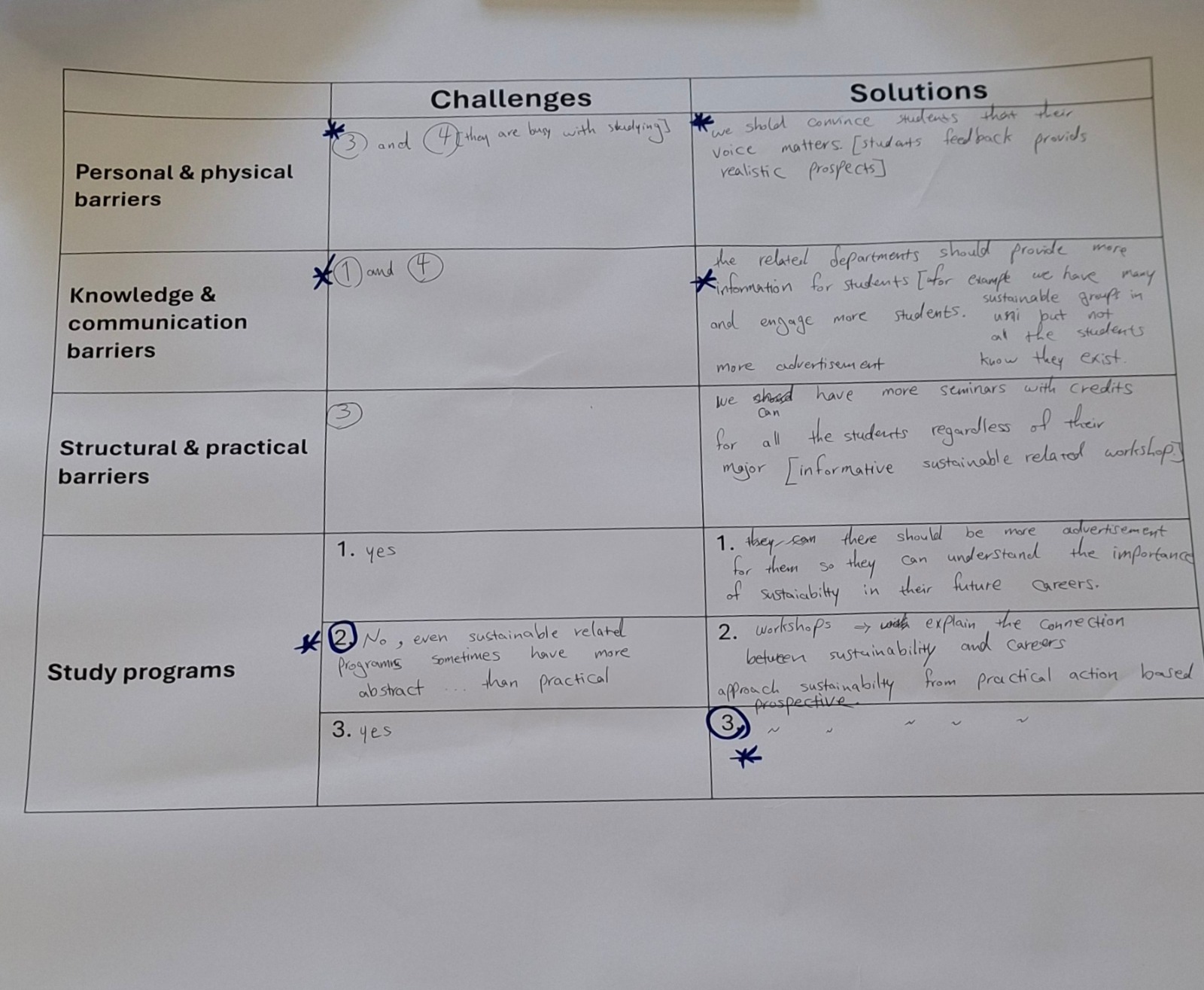
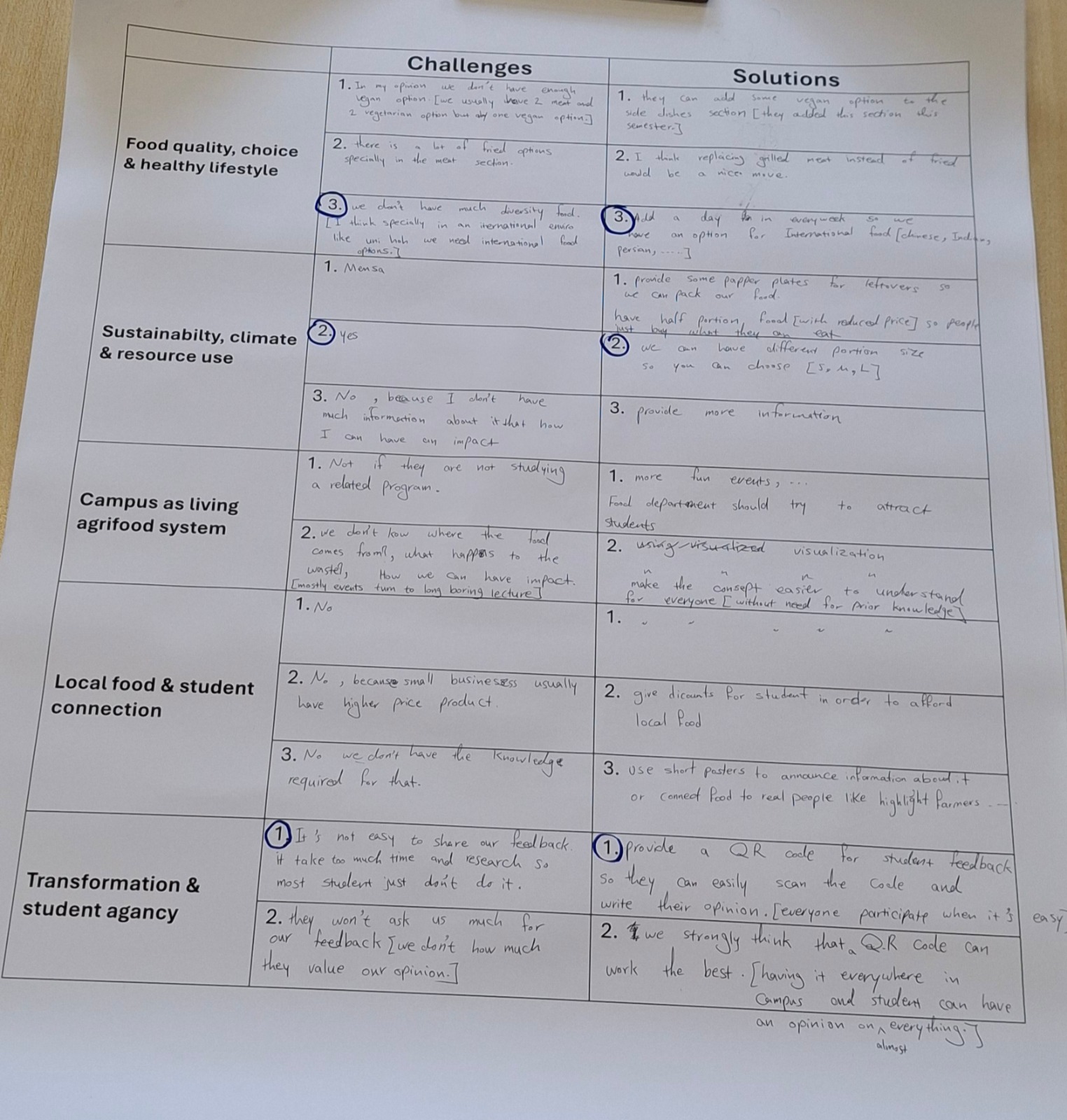
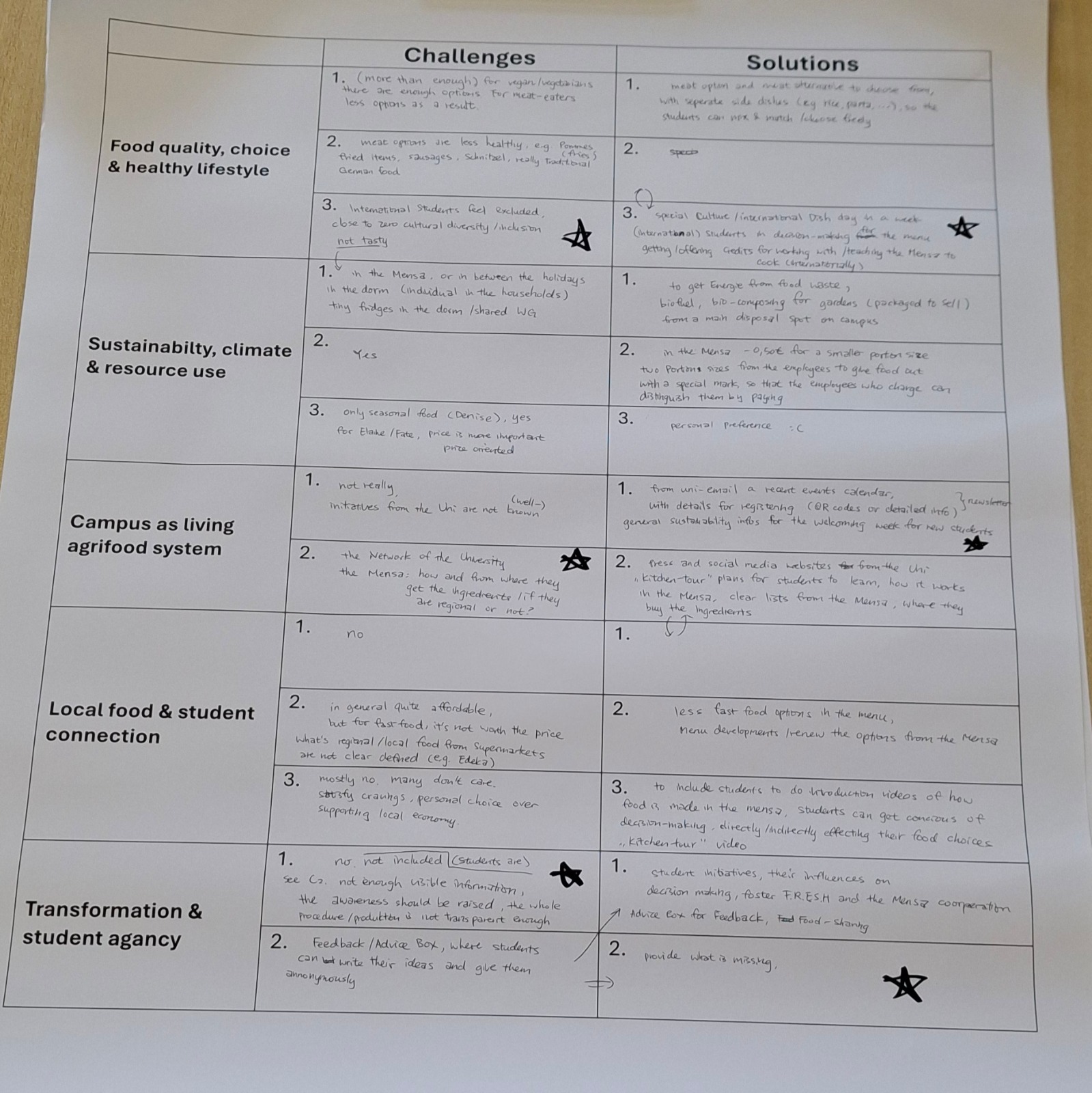
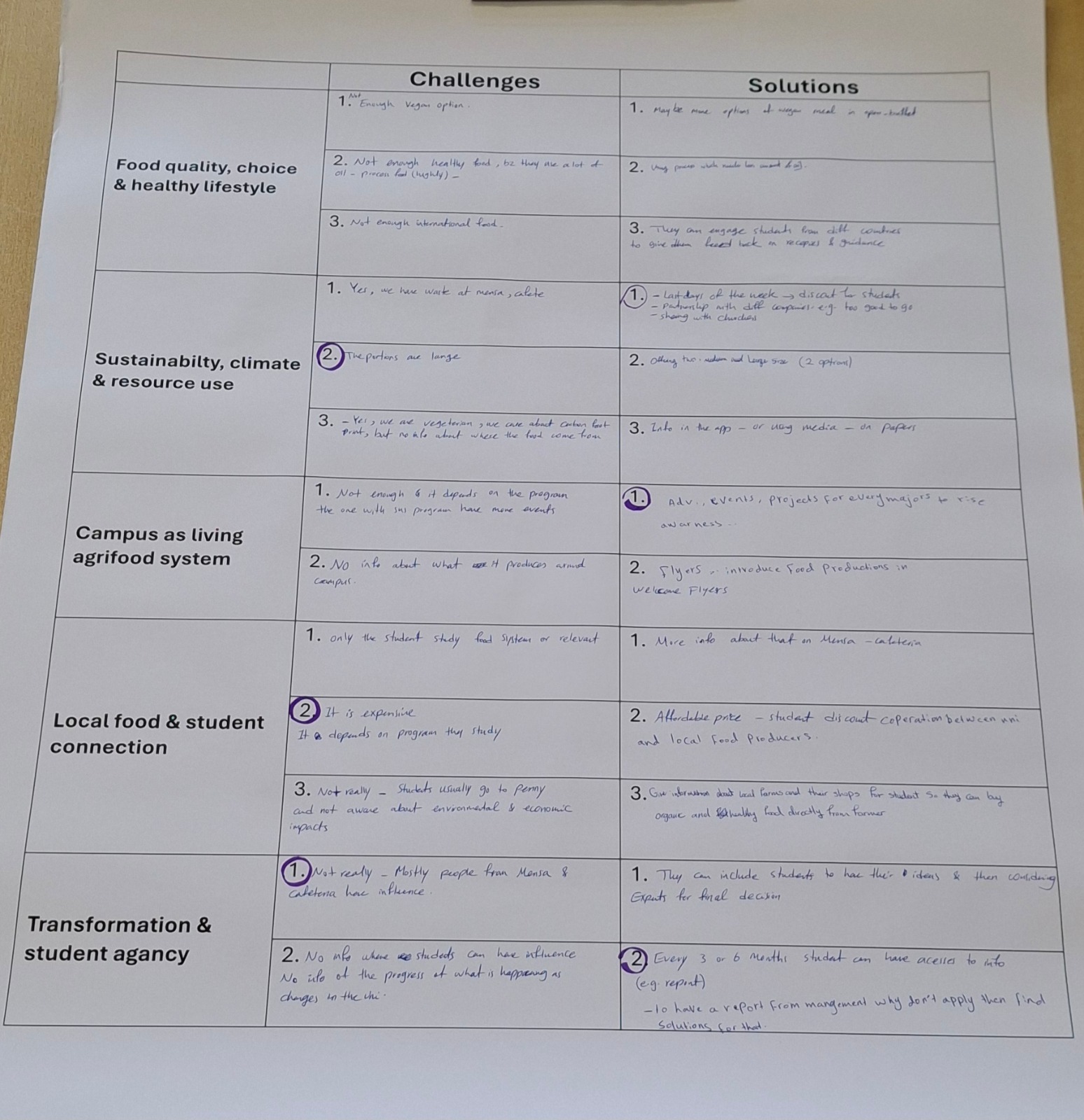
These images show the posters used during the workshop where students directly shared their ideas and feedback. Participants wrote their answers, challenges, and proposed solutions on the posters in response to guided questions. The posters capture the raw and collaborative nature of the discussion and illustrate how students engaged with the topic of campus food systems. Click on any image to view it in full size.
📊 Workshop Results & Data
These spreadsheets summarize the main insights collected during the campus food workshop. Participants discussed challenges related to food quality, sustainability, local food systems, and student agency, and proposed practical solutions. The files compile participants' responses into a structured format to highlight recurring themes and ideas generated during the discussions.
📗 Result: Food on Campus
Comprehensive data on campus food challenges and solutions, covering food quality, sustainability, campus food systems, local food, and student agency.
Key Results
The workshop results reveal several areas of strong agreement among participants as well as topics
requiring further discussion. Flexibility in portion sizes achieved full consensus among participants as
both a challenge and a solution, highlighting it as an immediate opportunity for implementation to reduce
food waste and improve student satisfaction. Similarly, financial access to regional products and
transparency regarding food sourcing and waste management also reached full agreement, with students
supporting solutions such as student discounts, QR codes, or kitchen tours to better understand the campus
food system. In contrast, the issue of Mensa plate waste showed a strong consensus that the problem
exists, but no unified solution was identified. Participants proposed different ideas, including takeaway
options, leftover boxes, or partnerships with initiatives such as Too Good To Go, indicating that further
discussion is needed to determine the most suitable approach. A similar pattern emerged regarding student
influence on campus food decisions: while participants unanimously felt that students currently have
limited impact on decision-making, there was no single preferred solution. Suggestions ranged from
publishing regular progress reports to creating a student seat on the culinary board or establishing a
transparency dashboard. Overall, the results highlight several “quick win” opportunities for immediate
action, while other areas call for continued collaboration to identify the most effective solutions.
View Data Table
| Food on Campus | Category | Question | Challenge | Challenge Consensus Score | Comment | Solution | Solution Consensus Score | Comment.1 |
|---|---|---|---|---|---|---|---|---|
| 1. Enough vegetarian and vegan options? | Food Quality | Availability of vegan dishes | 2.0 | 0.6666666666666666 | Only one vegan options | 3.0 | 1.0 | Add vegan side dishes |
| 2. Healthy vs fast food challenge? | Food Quality | Health & oil content of meals | 3.0 | 1.0 | Too much fried food | 2.0 | 0.6666666666666666 | Offer gridle alternatives |
| 3. Cultural diversity of food? | Food Quality | Cultural diversity of the menu | 3.0 | 1.0 | Lacks cultural variety | 2.0 | 0.6666666666666666 | Weekly International Day |
| 1. Where do you see the biggest food waste problem on campus? | Sustainability | Management of Mensa leftover | 3.0 | 1.0 | Mensa plate waste | 0.0 | 0.0 | Different ideas: Takeaway options, leftover boxes or partnerships with organizations like Too Good To Go |
| 2. Do portion sizes lead to a lot of leftovers or waste? | Sustainability | Flexibility of portion sizes | 3.0 | 1.0 | Fix sizes causes waste | 3.0 | 1.0 | S/M/L size options |
| 3. Do you consider the climate impact when choosing your meals? Why or why not? | Sustainability | Transparency of meal carbon footprint | 2.0 | 0.6666666666666666 | No info on meal impact | 2.0 | 0.6666666666666666 | Add info to app or labels |
| 1. Do students have enough opportunities to learn about food production outside the classroom (e.g. events, visits, projects)? | Campus System | Student awareness of campus food initiatives | 3.0 | 1.0 | Awareness limited to specific majors | 3.0 | 1.0 | Info event for all programs |
| 2. Which information about campus food production is missing or unclear for students? | Campus System | Transparency of food sourcing & waste | 3.0 | 1.0 | Sourcing & waste process unknown | 3.0 | 1.0 | Use QR code/kitchen-tour videos |
| 1. Do students know where their food comes from? | Local Food | Awareness of local food benefits | 2.0 | 0.6666666666666666 | Students prioritize price over impact | 3.0 | 1.0 | Posters highlighting local farmers |
| 2. Is local food perceived as affordable and relevant for students? | Local Food | Financial access to regional products | 3.0 | 1.0 | Local food is too expensive | 3.0 | 1.0 | Student discount for local food |
| 3. Do students see their food choices as supporting the local economy and environment? | Local Food | Connection between students & farmers | 3.0 | 1.0 | Higher reliance on budget discounter | 3.0 | 1.0 | Farm shop info on Mensa/cafeteria |
| 1. Do students currently have real influence on food related decisions on campus? Why or why not? | Student Agency | Ease of submitting student feedback | 3.0 | 1.0 | Current system takes too much effort | 2.0 | 0.6666666666666666 | Campus wide QR code system |
| 2. What supports or structures are missing for students to contribute to real change? | Student Agency | Student impact on decision-making | 3.0 | 1.0 | They feel their voice has no impact | 0.0 | 0.0 | Different ideas: Publishing formal progress reports every 3–6 months, establishing a student seat on the culinary board or creating a transparency dashboard to track feedback. |
What do the numbers in the columns of challenge and solution mean?
3 = all three groups of students have similar ideas for the question
2 = 2 out of 3 groups have similar ideas
0 = no similar ideas from the three groups
Score of 1.0 (Total Consensus): This was assigned when all three groups independently
identified the same specific challenge or proposed the same specific solution (e.g., all three
groups requested a QR-code feedback system).
Score of 0.67 (High Agreement): This was assigned when two out of the three groups provided matching
responses.
Score of 0.33 (Low Agreement): This was assigned when only one group identified a specific point or
the ideas were very loosely related.
Score of 0 (No Consensus/Different Ideas): This was assigned when the three groups provided entirely
different ideas or no overlapping themes were found.
Challenge high (1.0) + Solution high (1.0)
→ Strong transformation readiness
Challenge high + Solution low
→ Problem recognized but no clear strategy
Challenge low + Solution high
→ Idea-driven but not urgent
To avoid confusion, two bar charts created based on categories: The one on the left is for categories
Food Quality and Sustainability and the bar chart on the right is for the categories of Campus System,
Local Food and Student Agency.
📗 Result: Student Engagement
Insights into student engagement barriers and solutions, including personal, knowledge, structural, and program-related factors affecting student participation.
Key Results
The analysis of student engagement highlights both clear priorities and areas requiring further discussion.
Participants showed strong consensus that sustainability education on campus is currently too limited and
often restricted to students in related majors. There was full agreement that non-related programs are
largely excluded from sustainability learning opportunities and that sustainability courses are not
sufficiently accessible across faculties. However, despite this shared recognition of the problem, no single
solution reached consensus. Participants proposed several different ideas, including introducing a mandatory
sustainability module for all majors, creating a university-wide green skills certification, and developing
peer-to-peer mentoring between students from environmental and non-environmental programs. In contrast,
topics such as knowledge and communication barriers and the lack of career-related sustainability skills
showed strong agreement on both the challenges and the proposed solutions. Students supported clearer
communication and structured updates on campus sustainability initiatives, such as expert-guided progress
reports. Overall, the results indicate a strong demand for a more inclusive and integrated sustainability
education, while highlighting the need for the university to consolidate the various student proposals into
a coordinated strategy for broader engagement.
View Data Table
| Student Engagement | Question | Challenge | Challenge Consensus Score | Comment | Solution | Solution Consensus Score | Comment.1 |
|---|---|---|---|---|---|---|---|
| A. Personal & physical barriers | Personal & physical barriers | 2 & 3 | 1.0 | Feeling overwhelmed & law impact | 3.0 | 1.0 | Offer workshops and rise awareness |
| 1. Lack of interest | Knowledge & communication barriers | 1 & 4 | 1.0 | Low visibility of initiatives & lack of starting point | 3.0 | 1.0 | Use English and increase advertisement efforts |
| 2. Feeling overwhelmed | Structural & physical barriers | 3 | 1.0 | No incentives or rewards | 2.0 | 0.6666666666666666 | Host more social events to build community |
| 3. Feeling of „it doesn’t make a difference” | Exclusion of non-related majors | 3 | 1.0 | Business/Finance students feel excluded | 0.0 | 0.0 | Different ideas: creating a mandatory sustainability module for all faculties, launching a university-wide green skills certification and developing a peer-to-peer mentoring program between environmental and business students. |
| 4. Others (e.g. study, work, time) | Lack of sustainability course for all majors | 3 | 1.0 | Courses restricted to specific programs | 0.0 | 0.0 | Different ideas |
| B. Knowledge & communication barriers | Lack of careers & sustainability skills integration | 3 | 1.0 | Missing link to professional green skills | 3.0 | 1.0 | Report on progress and expert guidance |
1. Not knowing where to start
2. Too much technical language
3. Sustainability feels abstract or unclear
4. Poor visibility of initiatives
C. Structural & practical barriers
1. Lack of time
2. Activities don’t fit schedule
3. No incentives or rewards
D. Study programs
1. Do finance/economic/business students feel excluded?
2. Do non-sustainable related fields have any/enough sustainable related courses?
3. Are links to careers & skills missing?
What do the numbers in the columns of challenge and solution mean?
The first 3 questions: the number of proposed answers chosen. E.g. For personal and physical barriers,
Feeling overwhelmed & Feeling of „it doesn’t make a difference” was the most chosen answer among
groups.
For the rest of the questions: 3 = all three groups of students have similar ideas for the
question
2 = 2 out of 3 groups have similar ideas
0 = no similar ideas from the three groups
How does the score for the first 3 questions define? E.g. all groups agreed on 1 & 4, it is 100%
=1
Score of 1.0 (Total Consensus): This was assigned when all three groups independently identified the
same specific challenge or proposed the same specific solution (e.g., all three groups requested a
QR-code feedback system).
Score of 0.67 (High Agreement): This was assigned when two out of the three groups provided matching
responses.
Score of 0.33 (Low Agreement): This was assigned when only one group identified a specific point or the
ideas were very loosely related.
Score of 0 (No Consensus/Different Ideas): This was assigned when the three groups provided entirely
different ideas or no overlapping themes were found.
Challenge high (1.0) + Solution high (1.0)
→ Strong transformation readiness
Challenge high + Solution low
→ Problem recognized but no clear strategy
Challenge low + Solution high
→ Idea-driven but not urgent